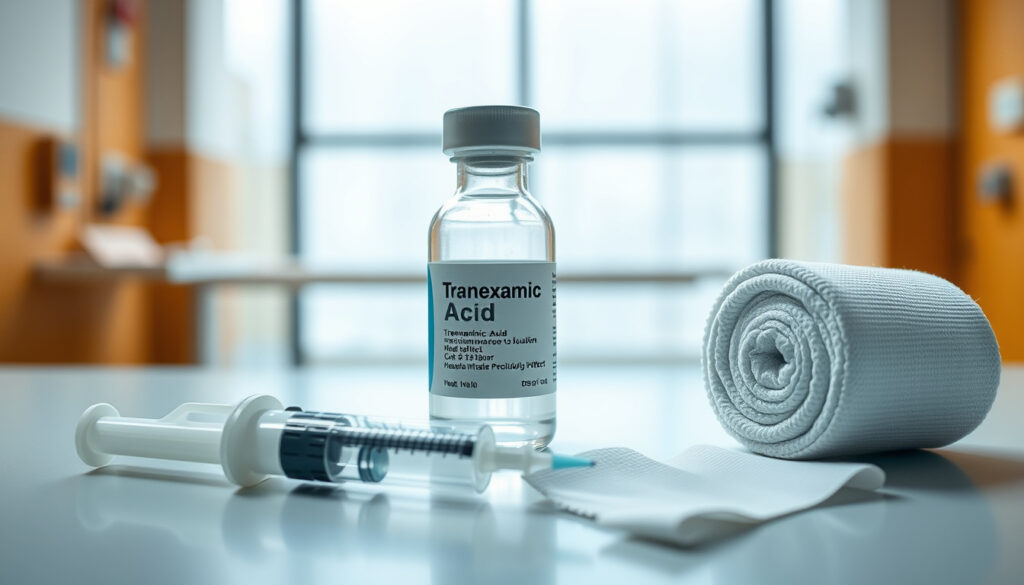
Tranexamic Acid – Guide till behandling och effekter
Introduction
Tranexamic acid (TXA) is a synthetic derivative of the amino acid lysine that has become a cornerstone in the management of bleeding across multiple medical disciplines. By competitively inhibiting the activation of plasminogen to plasmin, TXA stabilises clots and reduces excessive haemorrhage. Its role has expanded far beyond the original indications for menorrhagia and dental procedures in patients with haemophilia, now encompassing trauma, orthopaedic surgery, cardiac surgery, and even dermatology.
Grid of Key Applications
- Trauma & Emergency Medicine – Massive transfusion protocols and prehospital use.
- Orthopaedic Surgery – Total hip and knee arthroplasty to reduce perioperative blood loss.
- Cardiac Surgery – Reduces transfusion requirements in cardiopulmonary bypass.
- Gynaecology – Heavy menstrual bleeding, postpartum haemorrhage.
- Dermatology – Melasma and post‑inflammatory hyperpigmentation.
- Dental Medicine – Oral surgery in patients on anticoagulants.
Insights from Recent Research
Large randomised controlled trials have reinforced the efficacy of early TXA administration in trauma. The CRASH‑2 trial demonstrated a significant reduction in all‑cause mortality when TXA was given within three hours of injury. Subsequent meta‑analyses have confirmed these benefits without a corresponding increase in thromboembolic events. In elective orthopaedics, topical and intravenous TXA regimens have consistently lowered the need for allogeneic blood transfusion, length of hospital stay, and wound complications.
However, debate continues regarding the optimal dosing schedule and the patient populations most likely to benefit. Subgroup analyses suggest that the greatest effect is seen in patients with moderate to severe bleeding, while those with mild bleeding or very late administration may derive little advantage.
Clinical Evidence Summary Table
| Indication | Outcome | Quality of Evidence | Key Reference |
|---|---|---|---|
| Trauma (CRASH‑2) | Risk of death reduced by 1.5% | High (RCT, >20,000 patients) | Lancet 2011 |
| Total knee arthroplasty | Blood loss reduced by ˜300 mL | Moderate‑High (multiple RCTs) | J Arthroplasty 2017 |
| Postpartum haemorrhage (WOMAN trial) | Death from bleeding reduced by 19% | High (RCT, >20,000 women) | Lancet 2017 |
| Cardiac surgery | Transfusion rate decreased by 30% | Moderate (RCT, systematic review) | NEJM 2016 |
Detailed Mechanism and Pharmacology
Tranexamic acid exerts its antifibrinolytic effect by binding reversibly to the lysine‑binding sites on plasminogen. This prevents the interaction with fibrin, thereby inhibiting the conversion of plasminogen to plasmin. Plasmin is responsible for clot degradation; by blocking its formation, TXA preserves the integrity of the fibrin meshwork. The drug is well‑absorbed orally, with a bioavailability of approximately 34%, and reaches peak plasma concentrations within two to three hours. It is excreted largely unchanged in the urine, with a half‑life of about two hours in healthy adults.
Topical formulations are used in dental and dermatological settings, achieving high local concentrations while minimising systemic absorption. Intravenous administration is preferred in acute bleeding scenarios because of the rapid onset of action.
Historical Timeline of Key Milestones
- 1957 – Discovery of tranexamic acid by Japanese researchers.
- 1960s – First used for menorrhagia and haemophilia care.
- 1980s – Widespread adoption in cardiac surgery to reduce transfusion.
- 2004 – FDA approval for heavy menstrual bleeding.
- 2010 – Publication of CRASH‑2 trial transforming trauma management.
- 2017 – WOMAN trial establishes role in postpartum haemorrhage.
Clarity on Contraindications and Risks
Despite its favourable safety profile, TXA is not appropriate for every patient. Active thromboembolic disease (e.g., deep vein thrombosis, pulmonary embolism, myocardial infarction) is a contraindication because of the theoretical risk of promoting new or worsening thrombosis. Similarly, patients with a history of seizures should receive TXA cautiously, as high doses have been linked to convulsions in neurosurgical settings. Renal impairment requires dose adjustment to avoid accumulation. Allergic reactions are rare but have been reported.
Analysis of Controversial Areas
The most debated question is whether TXA increases the risk of thrombotic events in patients with an underlying prothrombotic state. Large randomised data, such as the CRASH‑2 and WOMAN trials, did not find a significantly higher incidence of vascular occlusive events. However, observational studies have suggested a slight elevation in risk among patients with existing cardiovascular disease. The balance of evidence supports the use of TXA when the bleeding risk outweighs the thrombotic risk, but individualised decision‑making remains essential.
Another area of uncertainty is the optimal timing for administration in traumatic brain injury. The recent CRASH‑3 trial found a survival benefit only in patients with mild to moderate head injury, not in those with severe injury. This has led to calls for more refined patient selection.
Expert Quotes and Clinical Perspectives
“For the bleeding patient, tranexamic acid is one of the few interventions that has a robust evidence base across multiple settings. The key is timeliness – it must be given early to be effective.”
– Dr. Ian Roberts, lead investigator of CRASH‑2 and CRASH‑3 trials
“In elective orthopaedics, TXA has become as standard as prophylactic antibiotics. The cost is low, the benefit is clear, and the complication rate is negligible.”
– Prof. Ola Rolfson, orthopaedic surgeon, Sahlgrenska University Hospital
Summary of Key Takeaways
Tranexamic acid is a well‑established antifibrinolytic with a robust evidence base spanning trauma, surgery, obstetrics, and dermatology. Its efficacy in reducing blood loss and transfusion requirements is supported by large randomised trials and meta‑analyses. The drug is safe when used in appropriate patient populations, though caution is warranted in those with active thrombosis or seizure history. Dosing and timing are critical variables that influence outcomes. Ongoing research continues to refine its indications and explore new applications, such as in melasma and elective cosmetic procedures.
Frequently Asked Questions
How does tranexamic acid stop bleeding?
It prevents the breakdown of blood clots by blocking the activation of plasminogen into plasmin, thereby stabilising existing clots.
Is tranexamic acid safe for everyone?
No. It is contraindicated in patients with active thromboembolic disease, known allergy, or a history of seizures (especially at high doses). Renal impairment requires dose adjustment.
Can tranexamic acid be given topically?
Yes. It is commonly used as a mouthwash in dental procedures and as an injection or cream in dermatology for conditions such as melasma.
Does tranexamic acid increase the risk of blood clots?
Large randomised trials have not found a statistically significant increase in thrombotic events, but caution is recommended in patients with prior clotting disorders.
For a deeper understanding of dosing protocols, see our guide on tranexamic acid dosing in clinical practice. You can also explore potential drug interactions with TXA.
Them bai lien quan
 So sánh MU và MC: Lịch sử đối đầu, thống kê và nhận định 2025
 Plagiarism – Đạo Văn Là Gì? Hướng Dẫn Toàn Diện Từ A-Z
 Turbologo – Công cụ tạo logo AI tốt nhất 2025
 Zeus: Thần sấm sét, vua Olympus và người tình Ganymede
 Đăng ký 4G Vina 50K/tháng: Cú pháp SMS và MoMo 2025
 Kết quả Cúp C2 hôm nay – Cập nhật tỷ số Europa League mới nhất
 Perchance AI OpenFuture: Nền tảng AI Sáng Tạo Miễn Phí
 Facebook.com Đăng Nhập Web – Hướng Dẫn Chi Tiết